


What does a Moroccan breakfast actually look like?
That sounds like a simple question, but there isn’t one fixed answer.
Breakfast in Morocco can be as simple as bread, olive oil and tea, or it can become a full table with different breads, spreads, dairy, eggs, fruit and drinks. What you find depends on the household, the region, the time of year and, honestly, how much time there is that morning.
That’s one of the things I like most about Moroccan breakfast.
It doesn’t have to look perfect.
It just has to feel like breakfast.
And because Moroccan food has strong regional identities, there is no single national breakfast plate that represents everyone. Moroccan cuisine changes from one region to another, which is part of what makes it so interesting in the first place.
So rather than pretending there is a universal checklist, I’ve put together 12 Moroccan breakfast foods and dishes that are worth knowing.
Some are breads. Some are sweet. Some are savory. Some are drinks.
Together, they give you a much better idea of what a Moroccan breakfast table can look like.
What Is a Moroccan Breakfast Like?
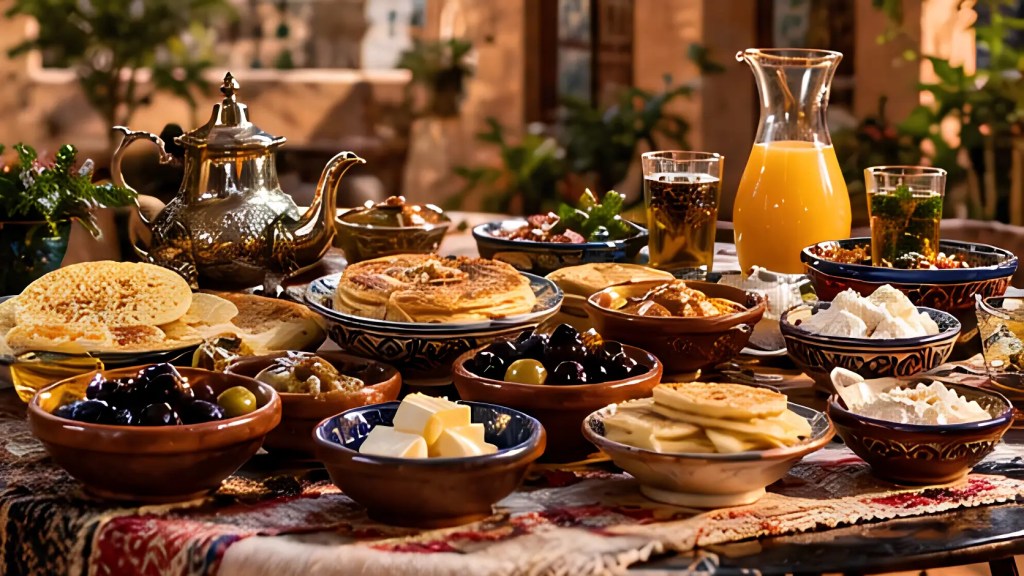
A Moroccan breakfast is often built around a few simple things: bread or pancakes, something to spread or dip into, a hot drink, and sometimes eggs, dairy, olives or fresh juice.
Bread is especially important in Moroccan food culture. The Moroccan National Tourist Office describes bread as a staple commonly served with traditional meals.
But the interesting part is what happens around the bread.
You might have something sweet beside something salty. You might tear off a piece of msemen and dip it into honey. You might spread amlou over harcha. You might have olives and cheese on the same table.
There isn’t necessarily a strict order.
It’s more of a table built around sharing.

And that is exactly why I think Moroccan breakfast deserves more attention outside Morocco.
1. Msemen

Let’s start with one of the most recognizable Moroccan breakfast foods: msemen.
Msemen is a layered Moroccan flatbread with a crisp exterior and soft, slightly chewy layers inside. It can be eaten plain, with butter and honey, or alongside savory ingredients.
For me, msemen is one of those foods that doesn’t need a complicated explanation.
You tear off a piece.
You add whatever is on the table.
You eat it.
That’s it.
The texture is what makes it special. The layers give it enough structure to work with both sweet and savory accompaniments.
And it can easily become the center of the breakfast rather than just a side.
2. Harcha

Harcha is another Moroccan semolina bread that deserves a place on the breakfast table.
Compared with msemen, harcha has a different personality. It is generally more crumbly and grainy, with a pleasant semolina texture that makes it feel substantial without being heavy.
I’ve already written about one version of it here:
👉 Stuffed Harcha: My Amazing 4-Ingredient Breakfast
That version is especially interesting to me because I took a familiar Moroccan base and turned it into something much more filling and portable.
That’s the kind of thinking I enjoy with food: start with something people recognize, then see what else it can become.
3. Baghrir
If msemen is layered and crisp, baghrir goes in the opposite direction.
Baghrir is the soft, spongy Moroccan pancake known for the tiny holes that cover its surface.
Those holes aren’t just there for appearance.
They make baghrir excellent at holding onto honey, butter or other toppings.
You get a soft bite followed by whatever you’ve spread across it, which makes the whole thing feel richer than the ingredient list might suggest.
Baghrir also shows why Moroccan breakfast isn’t simply about bread in the ordinary sense.
There are different textures, different cooking methods and different ways of serving the same basic idea: something warm, comforting and easy to share.

4. Amlou
Amlou is probably one of the most interesting things on this list for someone discovering Moroccan food for the first time.
It is traditionally associated with southern Morocco and the Agadir region and is made with argan oil, honey and almonds. The Moroccan National Tourist Office describes it as a well-known specialty of the south.
The combination sounds simple.
The flavor isn’t.
Amlou is nutty, rich, slightly sweet and deeply aromatic.
Spread it over bread, harcha or msemen and suddenly a basic breakfast becomes something much more memorable.
It is also a perfect example of how regional Moroccan ingredients can completely change the character of a breakfast table.
5. Moroccan Bread
Sometimes the most basic item is the one that explains the whole meal.
Moroccan bread comes in many forms, and bread plays an important role in everyday Moroccan food culture. The Moroccan National Tourist Office describes bread as a principal staple in Morocco.
At breakfast, bread can become the vehicle for almost everything else on the table.
Olive oil.
Honey.
Butter.
Amlou.
Cheese.
Jam.
Or simply a warm cup of tea beside it.
This is one of the reasons I don’t think Moroccan breakfast should be judged by the same standards as a plated Western breakfast.
The bread isn’t necessarily supporting the meal.
Sometimes it is the meal.
6. Olive Oil and Olives

A bowl of good olive oil and a small plate of olives can completely change a breakfast.
This is one of those combinations that looks almost too simple until you eat it.
Take some fresh bread.
Dip it into olive oil.
Add an olive.
Done.
Moroccan food culture makes a lot of room for simple ingredients that don’t need much decoration.
The country’s culinary identity is also strongly regional, so the exact ingredients and styles you encounter can vary considerably depending on where you are.
That’s something worth remembering whenever someone tries to define “traditional Moroccan food” with one fixed menu.
There isn’t one.
7. Honey and Butter
Some Moroccan breakfasts lean sweet, and honey and butter are two of the easiest ways to get there.
A warm piece of msemen, harcha or another bread with butter and honey is the kind of breakfast that doesn’t need much else.
The contrast matters.
Warm bread.
Creamy butter.
Sweet honey.
A little salt from the bread itself.
It works because none of the flavors are fighting for attention.
Moroccan culinary traditions often revolve around bringing contrasting flavors and textures together, and breakfast can be a very simple expression of that idea.
8. Fresh Cheese and Dairy
Dairy can also appear alongside Moroccan breakfast breads.
Depending on the region, this can include products such as lben, raïb, goat cheese or other local dairy products. The Moroccan National Tourist Office specifically highlights different dairy traditions across Moroccan regions.
This is another area where regional variation matters.
A breakfast in one part of Morocco doesn’t necessarily look exactly like breakfast somewhere else.
And I think that’s a good thing.
Food becomes much more interesting when it reflects where people actually live rather than being forced into one national template.
9. Eggs
Eggs are another flexible breakfast option.
They can be prepared simply and eaten with bread, olive oil, olives or other ingredients already on the table.
For me, eggs make sense because they can turn a lighter breakfast into something much more substantial without requiring a completely different meal.
This is also where personal preference really starts to matter.
One family might make eggs regularly.
Another might prefer breads, dairy and tea.
Someone else might have breakfast outside the home altogether.
So I wouldn’t tell you that every Moroccan eats the exact same breakfast every morning.
That simply isn’t true.
10. Moroccan Mint Tea

Now we get to the drink that is almost impossible to separate from Moroccan hospitality: mint tea.
Moroccan mint tea is more than just something hot to drink. The Moroccan National Tourist Office describes it as a ceremonial beverage deeply rooted in Moroccan traditions and often used when welcoming guests.
And this is the part I particularly like.
Tea isn’t necessarily something you drink while staring at the clock.
An official Moroccan tourism article describes tea as a social occasion — something not meant to be rushed.
That’s a completely different way of thinking about breakfast.
You aren’t just consuming something.
You’re sitting down.
Talking.
Eating.
Waiting.
Sometimes that’s what makes the meal memorable.
11. Moroccan Coffee
I can’t write about breakfast without mentioning coffee.
I’m a barista, so maybe I’m biased here.
But coffee belongs in the conversation.
Moroccan coffee has its own place in the country’s café and home-drinking culture, and traditional preparations can include spices. An official Moroccan tourism publication even describes beldi coffee as coffee sometimes flavored with spices.
For me, though, the bigger question isn’t whether coffee is “traditional enough.”
It’s how Moroccan breakfast and coffee can work together.
Strong coffee.
Warm bread.
A little honey.
Maybe something nutty like amlou.
That’s a combination I can easily imagine becoming part of a modern Moroccan café experience.
And that’s exactly the kind of idea that interests me when I’m thinking about Rayan Sip.
12. Fresh Orange Juice and Other Morning Drinks

Finally, there are the lighter morning drinks.
Fresh fruit juice, particularly orange juice, is a natural fit for a breakfast table, especially when the rest of the meal is built around breads and richer ingredients.
The Moroccan National Tourist Office highlights fresh fruit juice as part of Morocco’s food-and-drink culture, including the many juice vendors found around Marrakech’s Jemaa el-Fnaa.
Juice also changes the rhythm of the meal.
Tea can slow things down.
Coffee can wake you up.
Juice brings something fresh and bright to the table.
And sometimes that’s all you need.
What Does a Complete Moroccan Breakfast Look Like?
This is where things get interesting.
There isn’t one official plate.
A more substantial Moroccan breakfast could combine several of the foods above:
Msemen or harcha
Amlou or honey
Butter
Olives
Cheese or another dairy product
Eggs
Mint tea
Coffee or fresh juice
You could have all of them.
You could have three.
You could have one piece of bread and a glass of tea because you’re already late for work.
That’s still breakfast.
The important thing is understanding that Moroccan breakfast is less about one standardized recipe and more about a collection of foods that can be combined in different ways.
Why Moroccan Breakfast Isn’t One-Size-Fits-All
This is something I wanted to make clear because food articles often oversimplify Morocco.
Moroccan cuisine is strongly shaped by regional identity. Fes, Marrakech, Agadir and other parts of the country have their own culinary characteristics and ingredients.
So when you see a list called “the traditional Moroccan breakfast,” treat it as a selection rather than an official national rulebook.
That’s especially important with a country as geographically and culturally varied as Morocco.
A breakfast from the south can feel different from one in the north.
A family breakfast can feel different from a café breakfast.
A weekday breakfast can feel completely different from a weekend table.
And all of those can still be genuinely Moroccan.
Why This Food Interests Me
This isn’t just a food list for me.
I’m building Rayan Sip, and one of the questions I keep asking myself is:
What happens when familiar Moroccan food meets the way people actually eat today?
People are busy.
Some want to sit down.
Some have ten minutes.
Some want something traditional.
Others want something new.
That doesn’t mean traditional food has to disappear.
It means there may be room to reinterpret it.
I’ve already been exploring that idea with Moroccan-inspired croissant sandwiches, including six Moroccan croissant sandwich ideas I’ve been thinking about.
I’ve also explored stuffed harcha as a more substantial breakfast.
Those experiments are part of the same question.
How can something familiar remain recognizable while becoming more practical, more modern or simply more interesting?
From Moroccan Breakfast to Rayan Sip
That question is one of the reasons Moroccan breakfast matters to me as I develop Rayan Sip.
I don’t want to take traditional Moroccan food and put it on a menu just because “Moroccan” is a good marketing word.
I want to understand the food first.
Then I want to see where there is room to create.
That’s also why I’ve been documenting the project publicly instead of pretending everything is already finished.
You can read the story behind Rayan Sip or see how the café business itself is being structured as I work through the idea.
The café isn’t open yet.
Some of the food concepts I’ve written about are ideas rather than dishes I’ve already put into a commercial kitchen.
And I’m okay saying that.
I’d rather be honest about what I’m testing, what I’m imagining and what still needs work.
A Moroccan Breakfast Table Is More Than Food
For me, the best part of Moroccan breakfast isn’t any single ingredient.
It’s the combination.
Bread next to olives.
Honey beside butter.
Amlou beside tea.
Something sweet beside something salty.
And people sitting around the same table.
Moroccan food culture places real importance on sharing, conviviality and hospitality, and that spirit is reflected far beyond breakfast itself.
That’s the part I don’t want to lose when thinking about a modern café.
I want the food to feel familiar enough that a Moroccan customer recognizes something.
But different enough that they become curious.
That’s the kind of thinking I want behind Rayan Sip:
Start with something familiar, respect where it comes from, then ask what else it could become.
A note about the images
The photographs currently used in this article are AI-generated visual representations of Moroccan breakfast ideas. They are being used because Rayan Sip is still a pre-launch café and I do not yet have a full library of original food photography.
Once the café opens, I plan to replace these visuals with real photographs of the food we actually prepare.
Discover more from Rayan Sip
Subscribe to get the latest posts sent to your email.


