
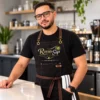

There are things you learn because someone teaches you. And then there are things you learn because you spend years doing them, again and again, until your hands know them better than your memory does.
For me, Moroccan mint tea belongs to the second category.
Since I was a teenager, I’ve loved making tea. In my village, an old friend and I became known for making what people considered some of the best tea around, especially during weddings, holidays, and family celebrations.
I never thought of it as a skill that would follow me for years.
I just knew people liked what we made.
Years later, that same skill would bring an old teacher of mine back into my life in a way neither of us saw coming.
I’ll get to that story, because honestly, it’s one of the reasons I wanted to write this article.
What Makes Moroccan Mint Tea Special?

Moroccan mint tea can look simple.
Tea. Water. Mint. Sugar.
But the preparation is where everything actually happens.
For me, the process is about controlling the strength of the tea, washing it properly, letting it develop, then mixing it with mint and sugar before serving it with the characteristic foam on top.
The type of tea also changes how I begin.
That’s why I use two different methods depending on what I’m working with.
Method One: When I Use Al-Hboub Al-Mkarkba

The first method is for the rolled, pellet-like tea that I call الحبوب المكركبة (al-hboub al-mkarkba).
I start by putting the right amount of tea into the teapot.
Then I add roughly one medium glass of boiling water.
I leave it for about two minutes, giving the tea time to release its concentrated flavor.
Here’s the part that matters most:
I don’t throw that first tea away.
After two minutes, I pour the concentrated tea into a glass without stirring the teapot, and set it aside.
That concentrated tea is too valuable to lose.
Then I add cold water to the teapot and stir it, washing the tea and removing the impurities.
I return the saved concentrated tea to the pot, add more cold water, and put it over low heat until it gradually reaches a boil.
Once it boils, mint goes in first, then sugar according to taste.
I mix it properly.
Then comes the part I enjoy most.
I take a glass, pour some tea into it, and return it to the teapot.
I repeat this several times.
This mixes the tea, mint and sugar together while developing the white, golden foam I’m always looking for before serving.
Method Two: When I Use Al-Sha’ra
The second method is for the looser, strand-like tea that I call الشعرة (al-sha’ra), and it’s simpler.
I don’t do the initial concentration step.
The tea goes directly into the teapot.
Then I add cold water and put it over low heat until it boils.
From there, I follow the same basic process.
Mint goes in first, followed by sugar according to taste.
I mix the tea properly and repeatedly pour it between the glass and the teapot until that white, dense foam develops.
Neither of these methods came from a recipe book.
They came from years of making tea for real people, at real gatherings, learning what worked by doing it over and over.
The Flavors I Sometimes Add

Moroccan tea doesn’t always have to taste exactly the same.
Depending on the occasion, the season, or simply what I feel like making, different aromatics can change the whole experience.
Over the years, I’ve used:
- Saffron
- Thyme
- Sheba (الشيبة)
- Lemon blossom
- Anise
- Al-kamoun al-soufi (الكمون الصوفي)
- Cloves
- Lavender
- Basil
- Fliou (فليو)
- Licorice
- Chamomile
And there are many other possibilities.
There isn’t one single way that I believe every glass of Moroccan tea has to taste.
Sometimes the traditional version is exactly right.
Sometimes one aromatic ingredient changes everything.
For me, that’s part of what makes tea interesting.
The Question Customers Ask Me Every Day
At Le Pain Bul, customers have asked me many times what I put in my tea because they notice that it tastes different.
That question always makes me smile.
Because there isn’t one magic ingredient I can point to.
The secret is really the method.
Knowing the tea you’re working with.
Knowing how strong you want it.
Knowing when to add the mint.
Knowing how much sugar works for the person you’re serving.
And mostly, it comes from doing it again and again, since I was a teenager.
That’s the part that is difficult to put into a recipe.
A recipe can tell you what to add.
Experience teaches you when.
The Story of My Old Teacher
This is where the story I mentioned earlier actually happened.
Years after I left secondary school, I happened to meet one of my old teachers in Rabat.
Neither of us knew we were about to meet.
He had come to the city to take care of some business, and while he was there, he started asking people where he could find good tea in Rabat.
He had noticed something that many tea drinkers already know: some cafés simply add tea and boiling water and serve it without giving the preparation much attention.
He wanted something better.
By coincidence, he asked someone who happened to know me.
That person sent him straight to Le Pain Bul.
So my old teacher walked into the place where I was working.
And something strange happened.
As soon as I saw him, his face felt familiar, but I couldn’t place where I knew him from.
At the same time, he was looking at me as if he had seen me somewhere before.
We greeted each other and started talking.
I finally said:
“Your face is very familiar to me. I feel like I know you from somewhere.”
He asked me where I was originally from.
I told him that my roots are from Tiznit.
That was the missing piece.
Suddenly, we both remembered.
He was my old teacher from secondary school.
I was his former student.
We hugged right there.
Then he told me the story of how he had been asking people around Rabat where to find good tea, and someone had sent him to the place where I was working.
Without knowing it, he had walked straight back into the life of one of his former students.
I was genuinely so happy to see him.
Not only because he had come looking for my tea, but because one cup of tea had somehow brought back my childhood and my secondary-school years in a single afternoon.
I treated him with great pleasure that day.
And I still think about it.
What Tea Taught Me About Hospitality
Looking back, I think tea taught me something long before I fully understood it.
A drink can be technically correct and still have no personality.
You can put tea in a pot, add hot water and serve it.
But hospitality is different.
Hospitality is paying attention.
It’s knowing that someone may have been looking forward to that cup.
It’s noticing whether they like it sweet.
It’s taking the extra moment to prepare it properly.
And sometimes it’s simply the conversation that happens while the tea is being made.
That’s something I’ve carried with me through all my years behind café counters.
Could Moroccan Mint Tea Have a Place at Rayan Sip?
Absolutely.
It’s something I genuinely want to explore.
But Rayan Sip is still a pre-launch café project, so I don’t want to pretend that a final menu already exists.
What I can say is that Moroccan tea is exactly the kind of product I want to think about carefully.
Not simply:
“Should we serve Moroccan tea?”
But:
“How can we serve it in a way that respects what people already love while giving them a reason to experience it again?”
And I’d want to test different combinations before deciding what actually belongs on the final menu.
That’s how I want to approach Rayan Sip.
Test. Listen. Improve. Then serve.
What I’d Actually Test Before Putting Tea on the Menu
I wouldn’t start by creating ten different versions.
I’d start with the basics:
- Traditional mint tea — the benchmark everything else gets measured against.
- Different sweetness levels — because not everyone wants the same amount of sugar.
- Aromatic additions — saffron, thyme, sheba, lemon blossom, fliou and others, tested carefully rather than all at once.
- Tea and breakfast pairings — msemen, harcha, baghrir and amlou.
- Service time — a beautiful tea isn’t enough if it takes too long to serve during a busy morning.
- Customer reaction — most importantly, what people actually choose, not what I assume they’ll choose.
Because when I eventually open Rayan Sip, I don’t want to decide everything from behind a desk.
I want to learn from the people who actually walk through the door.
More Than a Recipe
When I look back at my relationship with Moroccan tea, I realize that it has been part of my life for much longer than Rayan Sip has existed.
It started when I was a teenager making tea with an old friend in my village.
It continued through weddings, holidays and family gatherings.
It followed me behind café counters.
It became something customers at Le Pain Bul noticed and asked me about.
And eventually, it helped bring an old teacher back into my life after years apart.
That’s why I don’t see Moroccan tea as just another recipe on a menu.
For me, it’s a piece of my own history.
And if it eventually finds its place at Rayan Sip, I don’t want it there simply because Moroccan tea belongs on a Moroccan café menu.
I want it there because it belongs to my story too.
A Few Things People Ask Me
What is Moroccan mint tea made from?
Moroccan mint tea is commonly prepared with green tea, fresh mint, water and sugar. The preparation and serving style are also an important part of the experience.
Is Moroccan mint tea always sweet?
Not necessarily. The amount of sugar can vary according to taste. When I prepare tea, I adjust the sweetness according to the people I’m serving.
Why do you pour the tea back and forth between the glass and the teapot?
I do it to mix the tea, mint and sugar properly while developing the white, golden foam I look for before serving.
Can Moroccan tea have different flavors?
Yes. In my own experience, I’ve prepared tea with additions such as saffron, thyme, sheba, lemon blossom, anise, cloves, lavender, basil, fliou, licorice and chamomile.
Is Moroccan mint tea served with breakfast?
It can be part of a Moroccan breakfast experience and pairs naturally with foods such as msemen, harcha, baghrir and other breakfast dishes.
Discover more from Rayan Sip
Subscribe to get the latest posts sent to your email.


